The Math Behind Maurer Roses
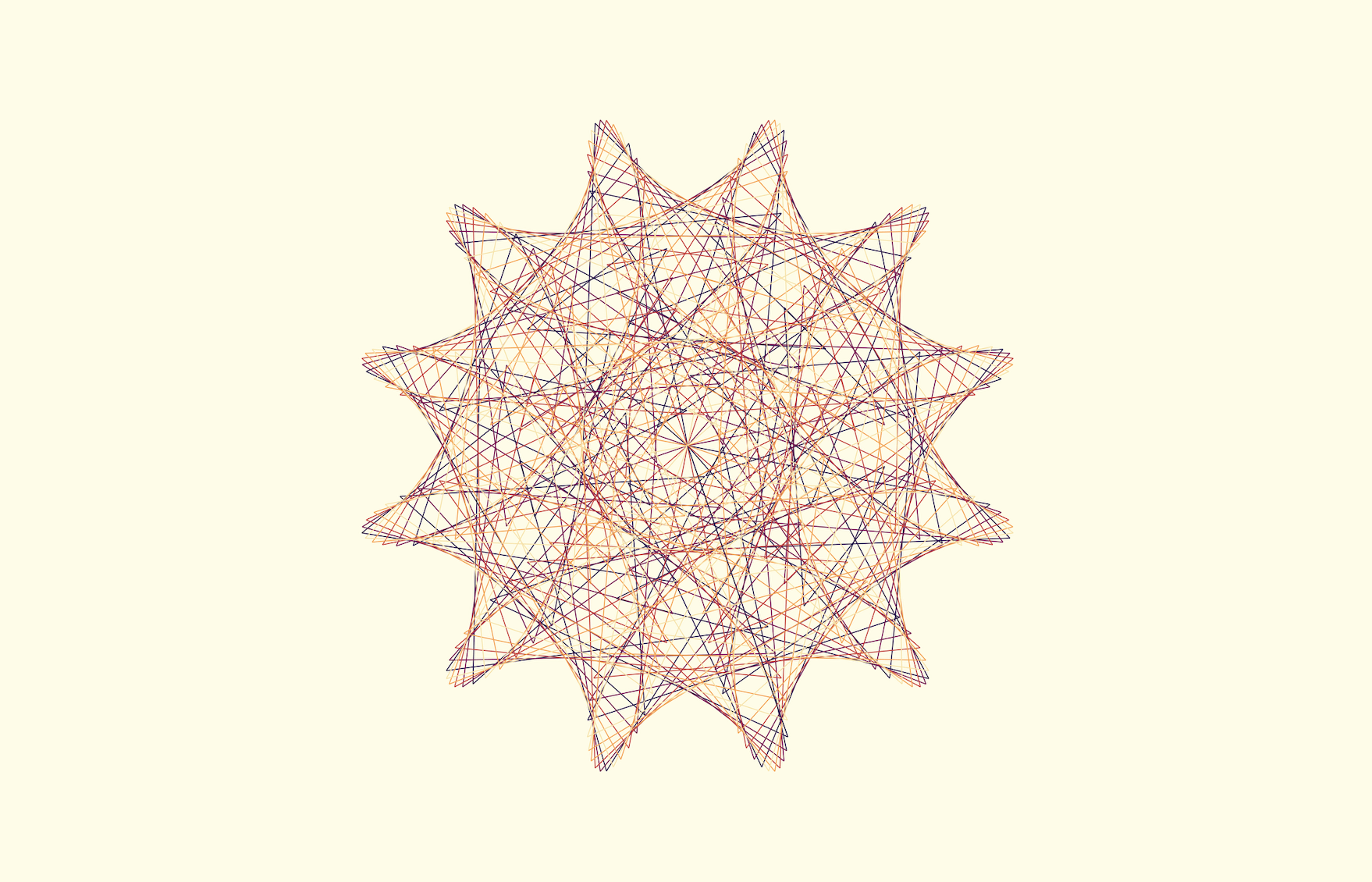
At first glance, a Maurer Rose looks like chaos. It is a mesh of sharp, angular lines that somehow form a soft, organic shape. But underneath that chaos is a perfect, smooth curve known as a Rose Curve.
A Maurer Rose is essentially a game of "connect the dots" played on top of that smooth flower.
The Foundation: The Rose Curve
Before we can draw the chaotic version, we need the smooth version. A standard rose curve is defined by the polar equation:
Where:
- is the radius (distance from the center).
- is an integer that determines the number of petals.
- is the angle (from 0 to 360 degrees).
If is odd, the rose has petals. If is even, it has petals.
The Twist: The Maurer Step ()
In 1987, Peter M. Maurer introduced the concept of the "Maurer Rose" in an article for The American Mathematical Monthly. His idea was simple but powerful: instead of drawing the curve smoothly (incremementing the angle by a tiny amount like 0.1°), what if we skipped ahead by a large amount, say degrees, at every step?
The algorithm works like this:
- Start at angle 0.
- Draw a line to the point on the rose curve at angle .
- Draw a line to the point at angle .
- Continue until you close the loop (usually 360 steps).
Mathematically, we are connecting the points:
Interactive Laboratory
Use the widget below to see this relationship.
- Toggle "Show Original Rose Curve" to see the smooth foundation.
- Adjust to change the number of petals.
- Adjust to change how we connect the dots.
Determines the shape of the underlying flower.
How many degrees to skip before drawing the next line.
Notice the patterns?
- When is small, the lines are short and trace the original curve closely.
- When is large, the lines jump across the center, creating the "web" effect.
- When or , you get stark geometric beauty because these numbers don't divide evenly into 360, causing the lines to cover the entire space before repeating.
References & Further Reading
- Wikipedia: Maurer Rose - A great overview of the history and basic definition.
- Wikipedia: Rose (Mathematics) - Deep dive into the properties of the underlying polar curve.
- Wolfram MathWorld: Maurer Rose - For the rigorous mathematical definitions.