The Ghostly Geometry of Clifford Attractors
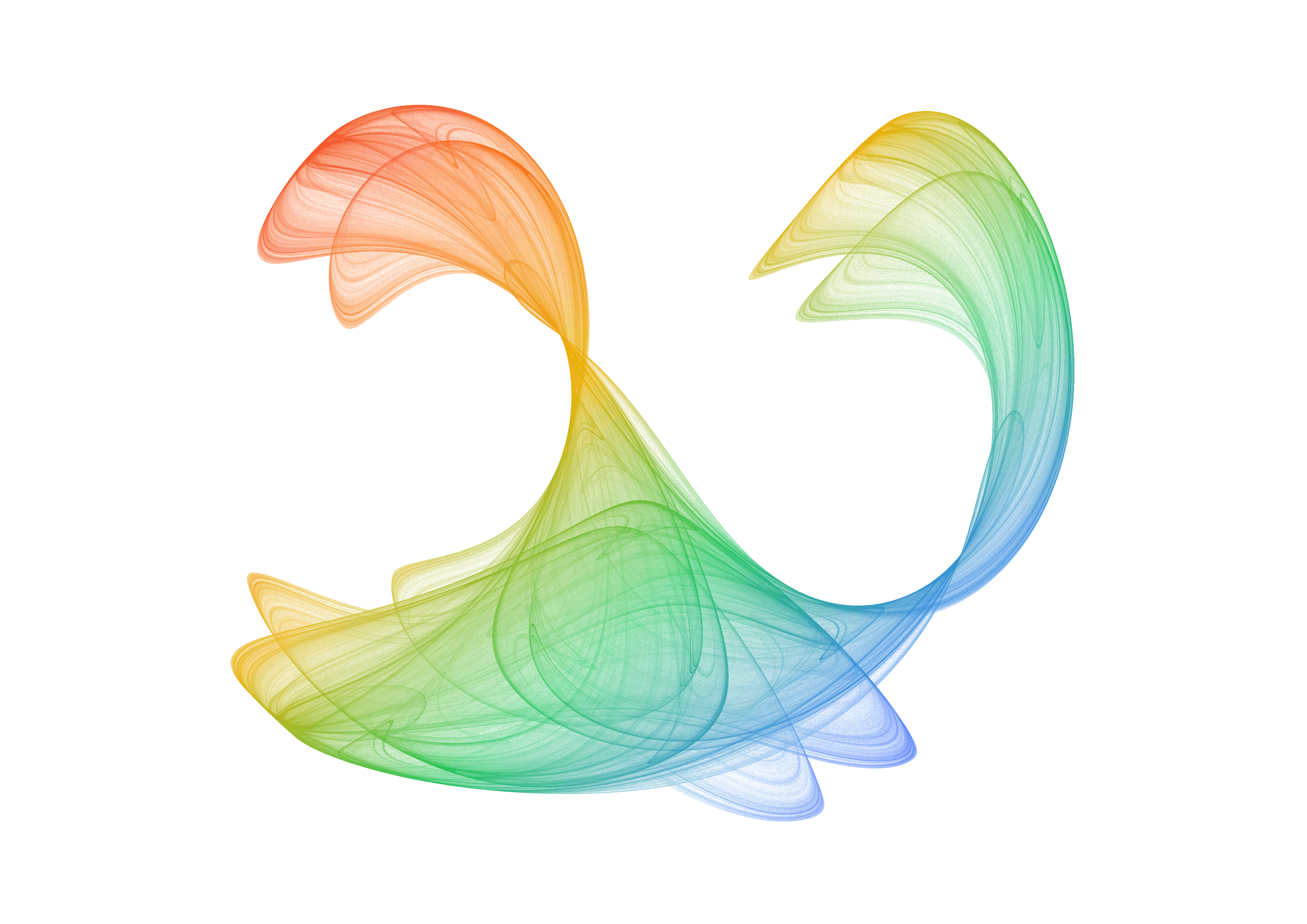
If the Maurer Rose is a game of "connect the dots," the Clifford Attractor is a long-exposure photograph of a firefly trapped in a mathematical jar.
It doesn't look like a standard geometric shape. It looks like folded smoke, or a topographic map of an alien planet. These ghostly forms are technically known as Strange Attractors, and they are a beautiful visual example of Chaos Theory.
The Foundation: The Pickover Equations
Discovered by Clifford A. Pickover, these attractors are defined by a system of iterative equations. Unlike the Rose, which calculates a static line based on an angle, the Clifford Attractor calculates a path.
We start with a point and calculate the next point's position using these formulas:
Where:
- are the coordinates of the current point.
- are the coordinates of the next point.
- are constants that shape the "magnetic field" of the attractor.
The Twist: The Density Map
The magic of the Clifford Attractor isn't in any single point—it's in the aggregate.
To create the visualization, we don't just calculate a few hundred points. We calculate millions. We simulate a particle jumping around the canvas based on the equations above.
- The Jump: The particle leaps from its current spot to a new spot determined by .
- The Trace: We don't draw lines connecting them. Instead, we mark the pixel where the particle lands.
- The Accumulation: We count how many times the particle lands on each specific pixel.
Pixels where the particle lands frequently become bright and opaque. Pixels where it rarely visits remain faint and transparent. This technique renders the probability distribution of the chaos, revealing the smooth, folded manifolds hidden within the math.
Interactive Laboratory
Use the widget below to manipulate the constants. Note how small changes can completely collapse or expand the shape.
- Adjust : These control the shape.
- Watch the rendering: Since this is a chaos simulation, the image "develops" over time as millions of points are calculated.
The shape "develops" as millions of points are calculated.
Notice the patterns?
- Sensitivity: Unlike the Rose, where changing a number slightly just rotates a petal, changing or here can completely destroy the shape and turn it into white noise.
- Bounds: Despite jumping infinitely, the particle never leaves a specific bounded area. It is "attracted" to this strange shape.
- 3D Effect: The variation in brightness creates a powerful illusion of depth, making the 2D image look like a folded 3D ribbon.
References & Further Reading
- Paul Bourke: Clifford Attractor - An excellent collection of parameters and examples.
- Wikipedia: Attractor - Understanding the concept of "Strange Attractors" in dynamical systems.
- Clifford A. Pickover: Computers, Pattern, Chaos and Beauty - The original work introducing these forms.